
15 Apartment Entryway Ideas That Work in a Tiny Space

Your apartment entryway is probably a hallway, a corner, or a slice of wall next to the front door, not an actual room. That’s the first thing to accept before you start decorating it. Most entryway inspiration online assumes you have a mudroom, a closet, and four feet of floor space to spare. You don’t, and that’s fine.
The real problem with small entryways isn’t a lack of style, it’s a lack of a plan. Shoes pile up because there’s nowhere for them to go. Bags get dropped on the floor because there’s no hook within reach. Keys disappear into coat pockets because there’s no tray waiting for them.
These apartment entryway ideas are built for exactly that kind of space: narrow, awkward, and short on floor room. Nothing here requires a renovation or a landlord’s permission for structural changes. Just smart use of wall space, a few well chosen pieces, and some honesty about what you actually drop the second you walk in the door.
Hang a Floating Shelf Above the Door Frame for Storage You Won’t Bump Into

Every tiny entryway has one spot nobody thinks to use: the wall right above the door frame. It’s blank, it’s out of reach, and your shoulder never bumps into it on the way in or out.
That makes it a good landing spot for things you don’t need in a hurry. A diffuser, a small stack of books, a trailing plant that spills down without blocking the door swing.
What actually belongs up there:
- Items you touch once a week, not once a day
- Anything light enough for basic wall anchors
- Decor, not daily gear like keys or mail
Keep the shelf shallow, around six to eight inches deep. Wider than that, and it starts to feel like it’s hanging over your head every time you walk through.
Swap the Floor Shoe Rack for a Wall-Mounted One

Move shoe storage off the floor and the whole entry feels wider, even though the square footage hasn’t changed. A wall-mounted rack sits above the baseboard, so the floor stays clear for sweeping and for actually walking through without stepping over sneakers.
Look for a rack with an angled design so shoes sit heel down instead of sticking straight into the walkway. Most versions hold six to eight pairs on a footprint smaller than one floor rack takes up.
The tradeoff is real. Wall mounting usually means a few small holes, and not every renter wants that. If your lease is strict, an over-the-door version gets you most of the benefit with zero drilling.
| Floor Rack | Wall Rack |
|---|---|
| Takes up floor space you’re walking through | Frees the floor for sweeping and walking |
| No installation needed | Usually needs a few small wall anchors |
| Easy to move when you rearrange | Stays put, holds shoes at an angle so they don’t stick out |
Lean a Full-Length Mirror Against the Wall to Trick the Eye Into More Space

A tall mirror leaned at a slight angle against the wall does something a hung mirror can’t. It catches light from across the room and bounces it straight back into the entry, so a dim hallway suddenly reads bigger and brighter.
Leaning it also skips the drilling entirely, which matters if you’re not allowed to put holes in a shared wall. A slim wood or metal frame in an arch shape looks intentional instead of like something waiting to be hung up later.
One rented entryway swapped a bare wall for a leaned mirror and nothing else. Same square footage, same lighting fixture, but the hallway photographed twice as wide.
A narrow, dim hallway with one bare wall and no light bounce.
Same hallway, one leaned mirror, and the space reads brighter and wider.
Mount a Multi-Hook Rail at Two Heights for Bags, Keys, and Coats

One rule fixes a crowded hook situation fast: not everything should hang at the same height. A single rail loaded with coats, bags, hats, and keys turns into a tangle within a week.
Split the rail into two zones instead. The upper row, around 55 to 60 inches up, holds the bulky stuff. The lower row, closer to 40 inches, holds what you grab without thinking.
Upper rail:
- Coats and jackets
- Structured bags
- Umbrellas
Lower rail:
- Keys
- A dog leash
- Tote bags or a school backpack
This split works especially well in shared entryways, since kids or shorter household members can actually reach their own hooks.
Two height zones, one rail
Choose a Slim Storage Bench Instead of a Regular One

Most people assume a storage bench needs at least two feet of depth to be worth buying. It doesn’t. A slim bench, closer to 12 to 14 inches deep, still fits a cushion, still gives you somewhere to sit while tying shoes, and still hides a shelf or two underneath for baskets.
The depth is the whole trick. Anything over 16 inches in a narrow hallway starts eating into the walkway, and you’ll catch your hip on it within the first week.
Best for: entries under four feet wide, renters who need seating and storage in one piece, anyone tired of shoes scattered across the floor.
Add a Small Pegboard for Keys, Sunglasses, and Mail

The mistake most people make is buying one big catchall tray and expecting it to hold everything. It doesn’t. Keys slide under mail, sunglasses get scratched by the mail, and within a month the tray is just a pile.
A small pegboard mounted near the door splits that pile into separate spots. Pegs for keys, a shallow pocket for sunglasses, a clip for mail that needs to go out.
It works best in entries where two or more people share the same drop zone, since everyone gets a peg instead of fighting over one tray.
💡 Quick Tip
Label each peg or pocket with a small tag for the first two weeks. It sounds fussy, but it’s how the habit actually sticks for the whole household.
Use a Round Mirror With a Tiny Catchall Tray Underneath
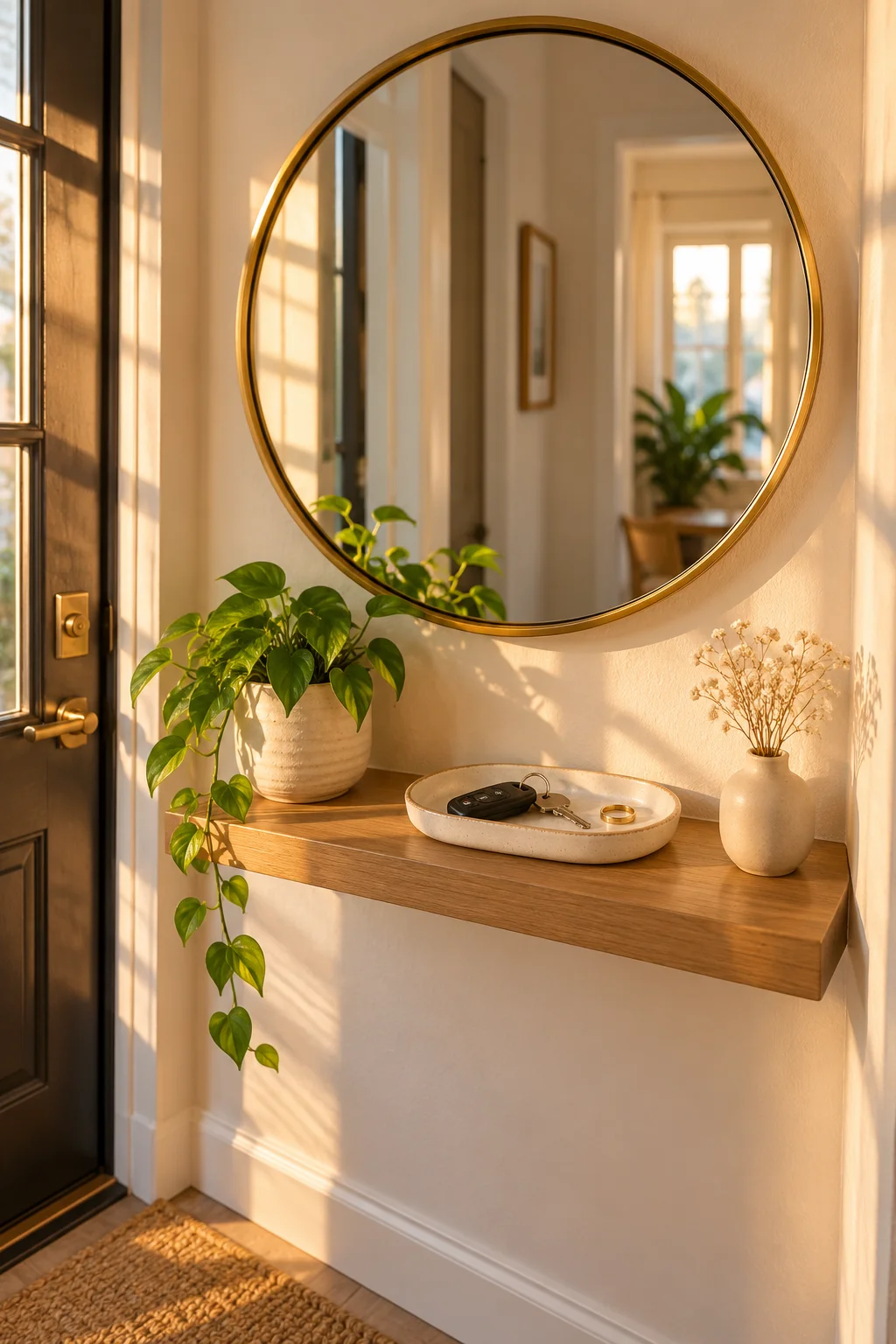
Soft curves next to sharp corners. That’s the visual trick here. A round mirror breaks up all the straight lines a tiny entryway usually has, from the door frame to the console edge, and it does it without taking up any floor space at all.
Underneath, a tray no bigger than a dinner plate holds whatever gets pulled out of pockets on the way in. Skip the temptation to size up the tray. A bigger one just invites more clutter.
Do this with a mirror between 20 and 24 inches wide. Anything smaller disappears on the wall, anything larger starts to feel heavy in a narrow space.
Pick a round mirror 20 to 24 inches wide.
Keep the tray small, dinner plate sized or less.
A mirror under 18 inches, it reads too small.
A deep bowl tray, it fills up and never gets emptied.
Stack Woven Baskets Instead of Buying a Shoe Cabinet

A shoe cabinet is a piece of furniture. Stacked baskets are just baskets, which means they can move with you, sit under a bench, or slide into a closet the second you don’t need them by the door anymore.
Here’s how to set it up:
Pick two matching baskets at least 10 inches deep so shoes don’t tip forward.
Stack them offset, not perfectly aligned, so the top basket stays easy to grab.
Sort by season, everyday shoes on top, rarely worn pairs on the bottom.
Cheaper than a cabinet, and it comes apart in thirty seconds on moving day.
Layer a Runner Rug Over the Doormat to Mark the Entry Zone

Walk into most apartments and the entryway just blends into the rest of the hallway floor. There’s no clear line where “coming inside” ends and “the rest of the apartment” begins.
A runner rug fixes that with almost no effort. Lay it just past the doormat, running the direction of foot traffic, and suddenly the entry has a defined edge, even in a space with zero walls to separate it.
A patterned runner does more to define a tiny entry than any piece of furniture. It gives the eye a boundary without needing a single wall.
Install a Narrow Console Table With One Drawer for the Essentials
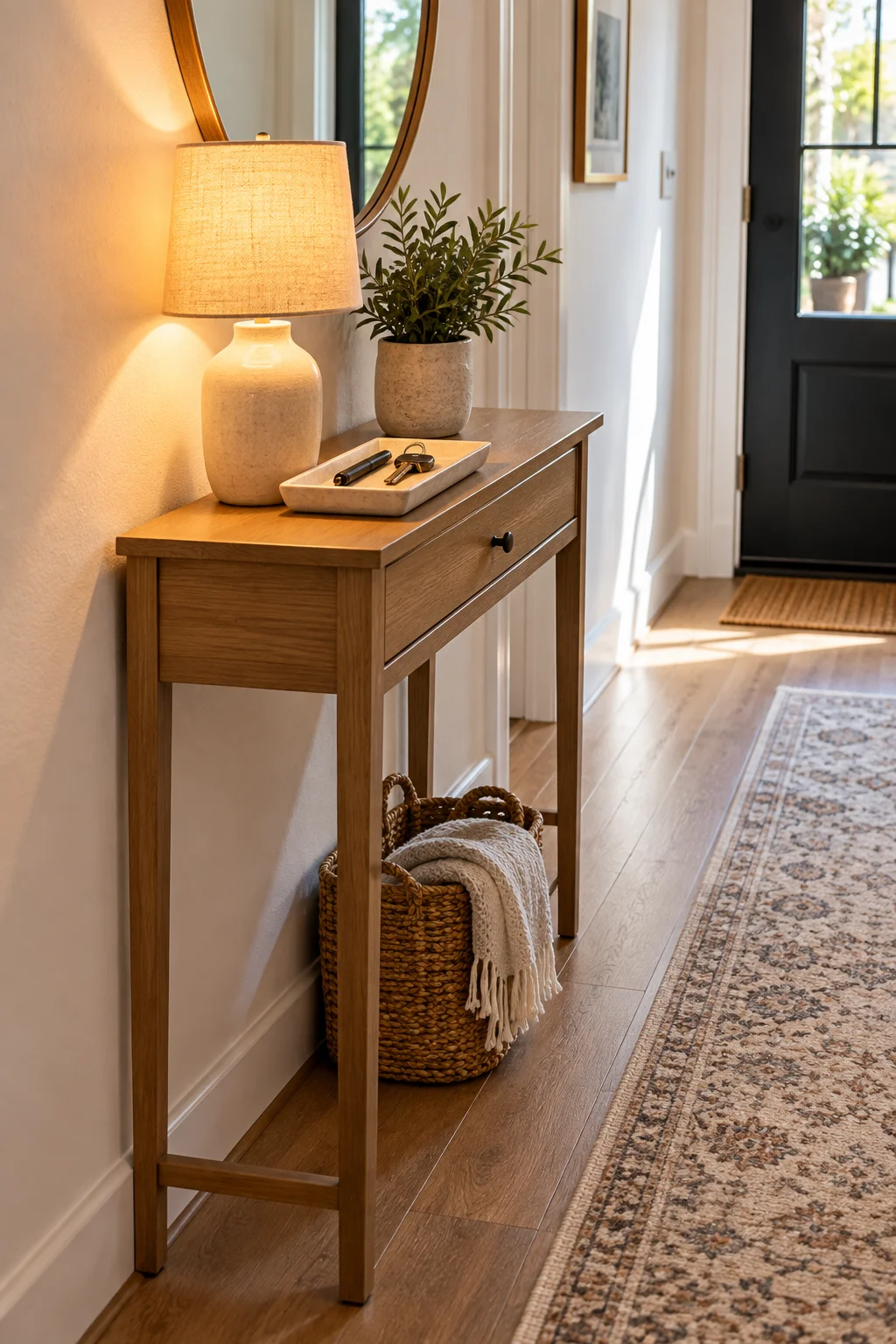
One drawer is the rule here, not two, not three. A single drawer forces you to keep only what actually belongs by the door: a spare set of keys, a pen, maybe a small flashlight. More drawers just become more places to lose things.
Stick to a table under 12 inches deep. Anything deeper starts to block the walkway in a hallway-style entry.
- Holds one drawer’s worth of essentials, nothing more
- Surface on top for a lamp, tray, or mail
- Under 12 inches deep so it doesn’t crowd the path
Works especially well tucked against the wall opposite the coat hooks, so the two zones don’t compete for the same few feet of floor.
- ▸One drawer only, keep it to true essentials.
- ▸Depth under 12 inches so it clears the walkway.
- ▸Top surface for a lamp, tray, or a small stack of mail.
Use Over-the-Door Hooks for Umbrellas and Seasonal Bags

No drilling, no anchors, no calling the landlord first. Over-the-door hooks slide over the top of the door itself and hold weight the second you hang them, which makes this the fastest fix on the whole list.
They’re best for things you don’t need daily. A wet umbrella, a gym bag that only comes out three times a week, a tote you rotate in for farmers market trips. Daily items still deserve a spot at eye level where you’ll actually remember them.
Add One Warm Light Source So the Entry Doesn’t Feel Like an Afterthought
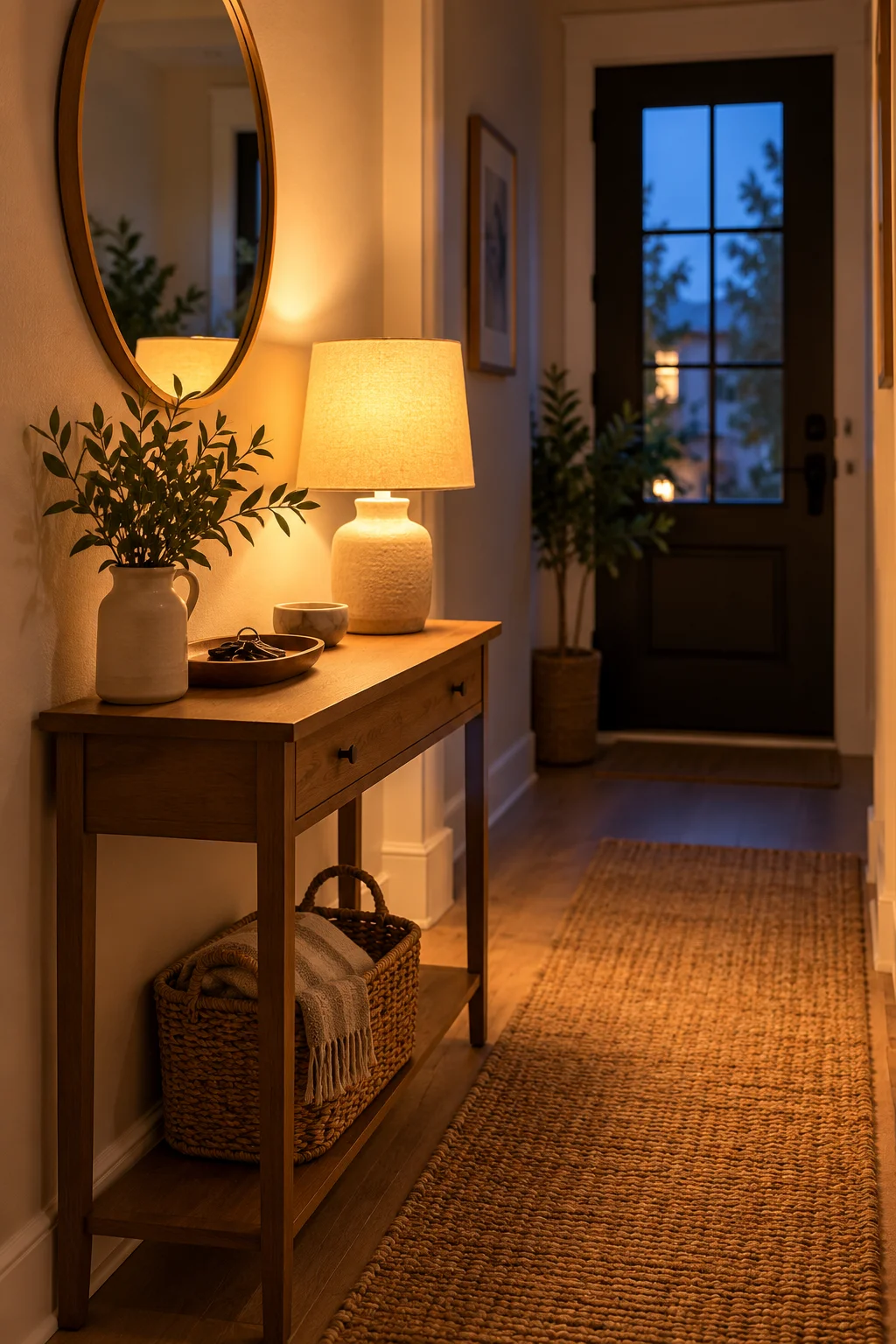
Most apartment entries run on one harsh overhead bulb, if they have any dedicated light at all. That’s the whole reason they feel like a place you pass through instead of a place you’d actually want to look at.
A small lamp on a console, or a plug-in sconce near the mirror, changes that instantly. Warm light in the 2700K range makes the space feel finished the second you walk in, even at eleven at night after a long shift.
💡 Quick Tip
Put it on a smart plug or a simple timer so the entry is already lit when you walk in after dark, instead of you fumbling for a switch.
Hang a Trailing Plant Instead of Setting One on the Floor

A floor planter in a narrow entry is just something else to step around. Move that same plant up onto a shelf or a wall hook and it stops competing with foot traffic entirely, while still bringing green into a space that’s usually all hard surfaces.
Pothos and philodendron both handle low light better than most houseplants, which matters in an entry that rarely gets direct sun.
A floor planter that gets kicked or stepped around near the door.
The same plant trailing off a shelf, out of the walkway and out of the way.
Give Everyone a Tiny Drop Tray for Keys and Wallets
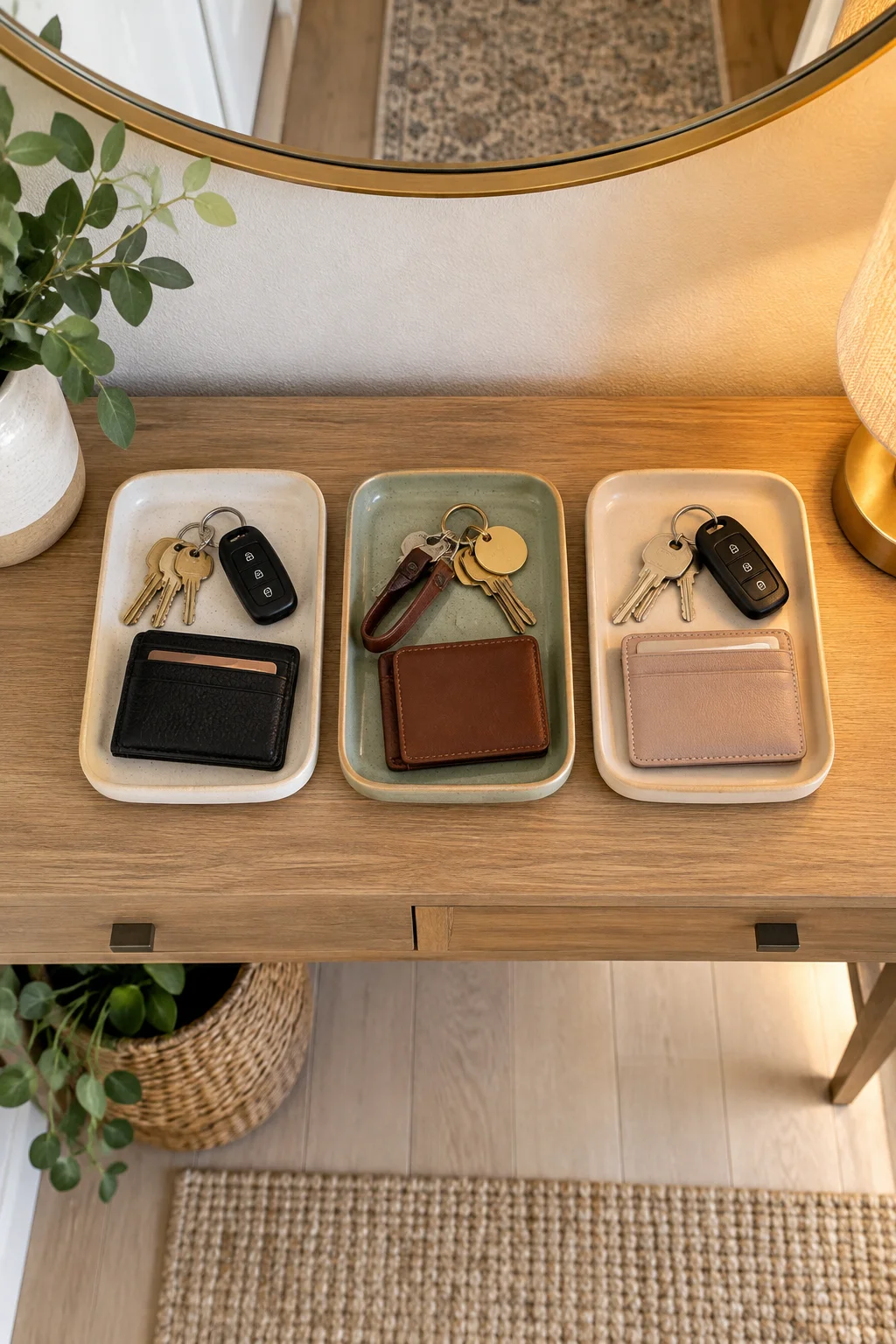
One shared tray sounds efficient until two people are digging through the same pile looking for their own keys. Splitting it up solves that in about the cost of two small dishes.
Give each person in the household their own small tray, no bigger than a coaster, lined up on the console or shelf. It only works if the trays are labeled or color coded at first, otherwise everyone drops into whichever one is closest.
- One tray per person, not one for the whole household
- Coaster sized, so it doesn’t invite extra clutter
- Color code or label for the first few weeks
Simple, but it’s the difference between a five second grab and a two minute search every morning.
Set it up right
Paint or Wallpaper Just the Entry Wall to Separate It From the Rest of the Room

In an open apartment layout, the entry and the living room are often just one continuous wall with no visual break at all. Painting or wallpapering only the entry section changes that without adding a single piece of furniture.
Stop the color where the entry ends, at a doorway edge, a corner, or a piece of trim. That stopping point is what makes the whole thing look planned instead of like you ran out of paint.
Color is one of the only ways renters can create a real boundary without touching a single wall. Use it to end the entry, not to fill the whole hallway.
Conclusion:-
A tiny entryway doesn’t need more furniture, it needs a plan for the five things that land there every single day: shoes, keys, bags, coats, and mail. Once each of those has one dedicated spot, the pile-up stops happening.
None of these apartment entryway ideas require a landlord’s sign off or a weekend of renovation. Most take an afternoon, a few wall anchors, and a little honesty about what actually gets dropped by your door.
Start with just one idea. The wall shelf, the two-height hook rail, or the leaned mirror are the easiest wins if you’re not sure where to begin.
Save this list for the next time your entryway starts sliding back into a shoe pile.
