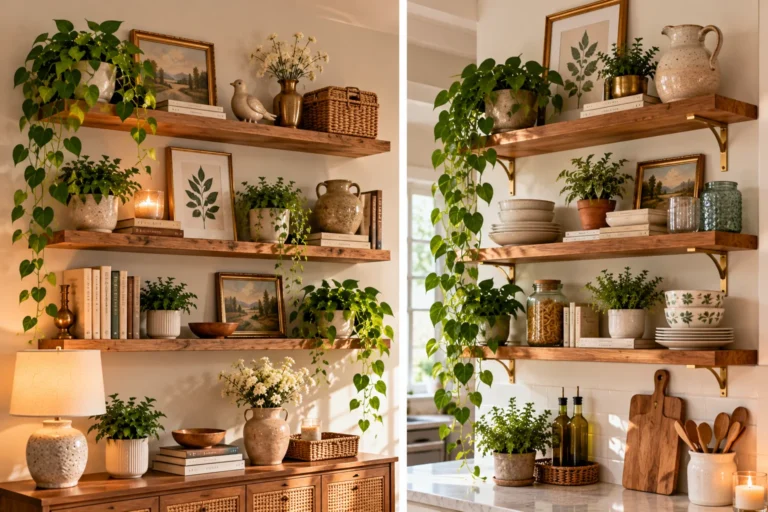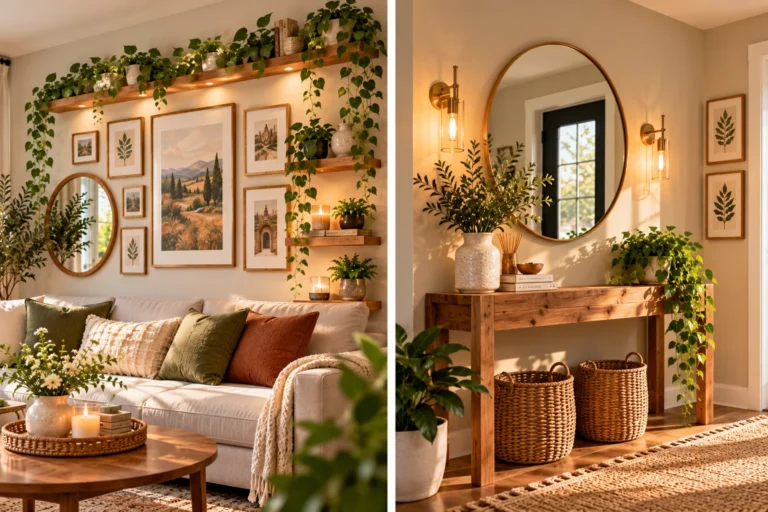
11 Empty Wall Decor Ideas for Awkward Blank Spaces

A blank wall looks simple until you have to decide what goes on it. The long hallway wall, the slanted stair wall, the stretch above a sofa, the corner nobody knows how to use. They all sit empty for months because every idea feels like a gamble.
These empty wall decor ideas come from real rooms, so you can see what works before you spend anything. Some use frames. Some use shelves, twine, plants, or a little built in light. A few cost almost nothing, and a few take a full weekend.
Here is what you will notice as you scroll. Most of the walls repeat one color or one wood finish, so the mix feels planned. The shapes vary, so the wall has some rhythm. And almost every one leaves a little breathing room, so nothing feels crowded.
Pick the awkward wall in your home that bugs you most, then find the idea below that fits its shape. Start with that one and see how it goes.
1. Staggered Floating Shelves Give a Blank Hallway Wall Life
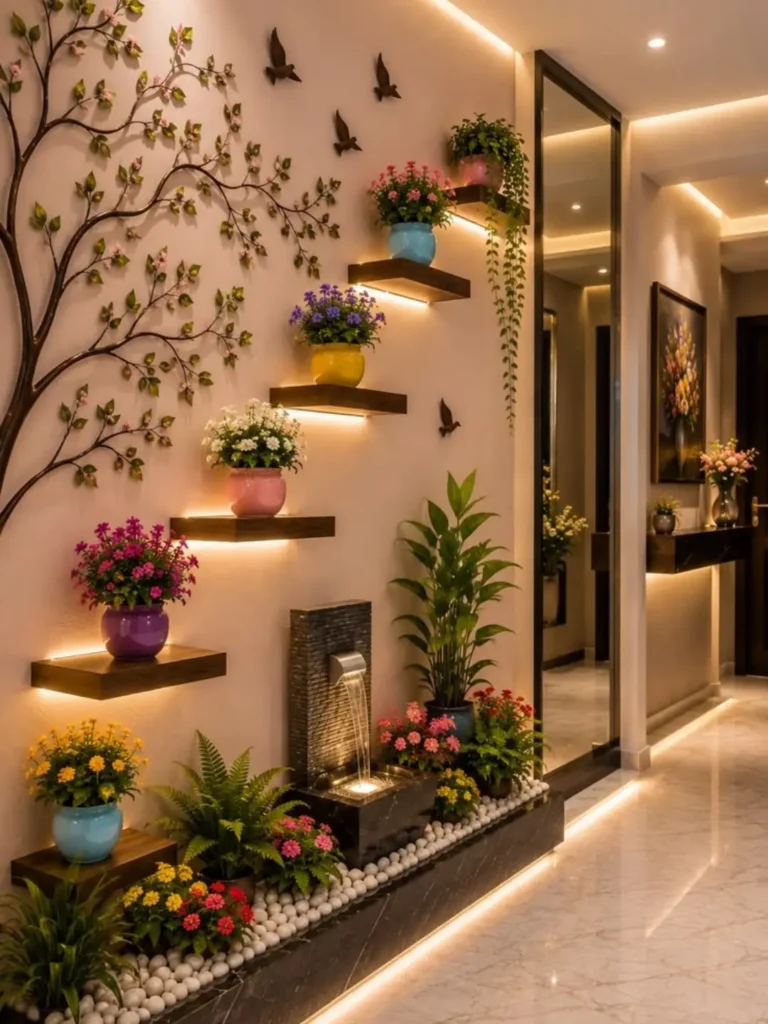
A tall wall beside a walkway is hard to fill, and this one answers it with height.
Five wood floating shelves step up the wall in a loose diagonal, each with a single potted flower in its own color: blue, yellow, pink, purple, and blue again. One pot per shelf keeps it from looking crowded. A strip of warm light under each shelf makes the whole thing glow at night.
The bare space above gets a metal tree branch with leaf details and a few small bird shapes, so the eye travels up the wall. Down at floor level, a low stone ledge holds ferns, a tall leafy plant, and white pebbles. A small water feature sits in the middle of it.
Hallway walls are narrow, so build up instead of out. Shelves that sit at different heights fill the wall without taking any floor space.
2. Twine Photo Strands Fill a Hallway Wall With Memories
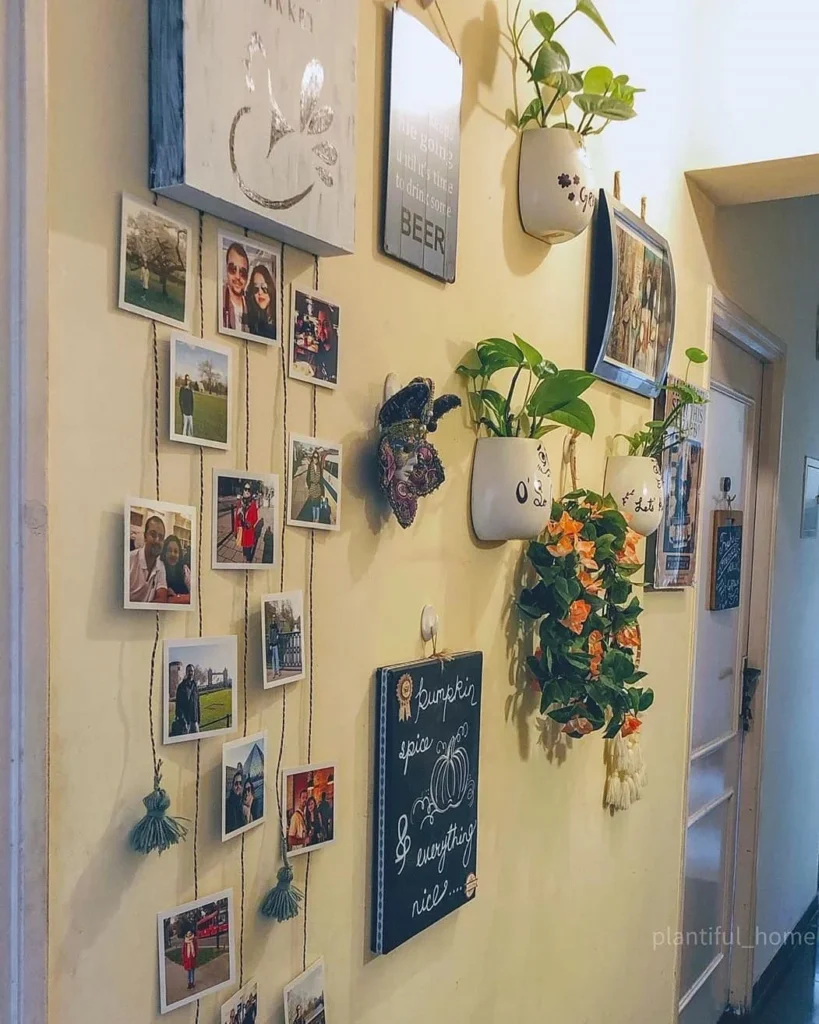
Photos do the heavy lifting on this wall, and the cost is almost nothing.
Here’s what makes it work:
- Long vertical strands of twine hang from a painted wooden sign near the top, so the photos fall in loose columns instead of a stiff grid.
- Square prints are clipped on at slightly different heights, which keeps the layout relaxed.
- Small tassels at the bottom of two strands finish the ends and add a soft color against the warm wall.
- Hanging planters and a few signs sit around the strands, so the photos are one layer of the wall and not the only thing on it.
The pale yellow paint gives the whole arrangement a sunny backdrop. Mixed textures like twine, wood, ceramic, and chalkboard keep it from feeling like a plain photo display.
Keep the prints light, because heavy frames will make the twine sag and pull the strands crooked.
How to get this look
Pick a sign or wooden board to anchor the top of the strands.
Hang three or four lengths of twine and let them fall at different lengths.
Attach square prints with mini clips, staggering the heights on each strand.
Tie a tassel to the end of one or two strands as a finishing touch.
Add a wall planter and a small sign beside the strands to balance the empty side.
3. Vintage Frames Climb a Slanted Staircase Wall Together
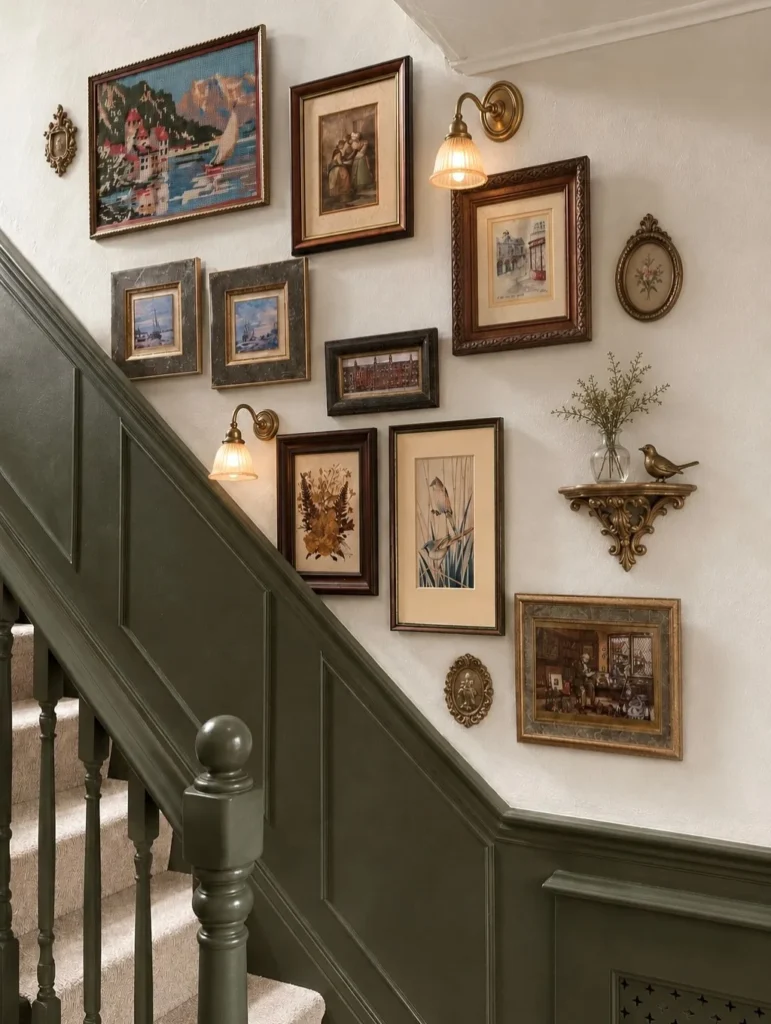
A slanted wall is one of the hardest blank spaces to fill, and this one solves it by letting the frames follow the stairs.
The group rises in the same direction as the railing, so it reads as one shape and not a pile of scattered pieces. Every frame repeats a dark wood or gold finish, which pulls very different art together. Big frames anchor the top and middle. Small oval frames fill the gaps between them.
Two brass wall lamps sit inside the group, so the light and the art share the wall. Near the bottom, a gilt bracket shelf holds a glass vase of greenery and a little brass bird, which adds depth that flat frames can’t.
The deep olive paneling below makes the pale wall above look brighter, and the old frames stand out against it.
Repeat one or two frame finishes, like dark wood and gold, across the whole group.
Fill the gaps between big frames with small ovals or a tiny bracket shelf.
Trace each frame on paper and tape it up first to test the angle.
Hanging the group as a flat square when the wall slopes.
Buying frames that all match in size and color.
Covering a wall lamp with art so the light has nowhere to land.
4. Peach Art and Woven Shapes Fill the Sofa Wall
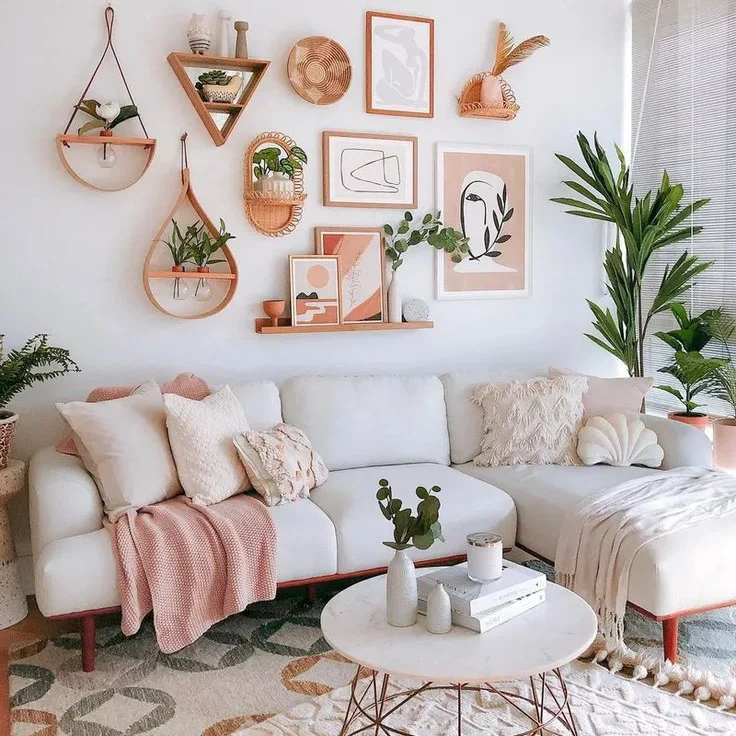
Sofa walls get dull fast when every piece on them is a rectangle. Here, the shapes do the work.
A triangle shelf, a teardrop shelf, and a round hanging shelf bring points and curves to the top half. A woven plate and a small rattan wall basket add texture. Framed line art prints in peach and cream sit in the middle, and a slim wood ledge below holds two small frames and a sprig of eucalyptus.
The palette stays warm and tight: peach, blush, cream, and natural wood. It picks up the knit throw and pillows on the sofa, so the wall and the seating look planned together. The little plants on the shelves add green, so the peach doesn’t take over.
Leave plain white wall showing between pieces. Those gaps keep a busy mix feeling calm.
5. A Carved Wood Ledge Anchors a Colorful Corner Gallery
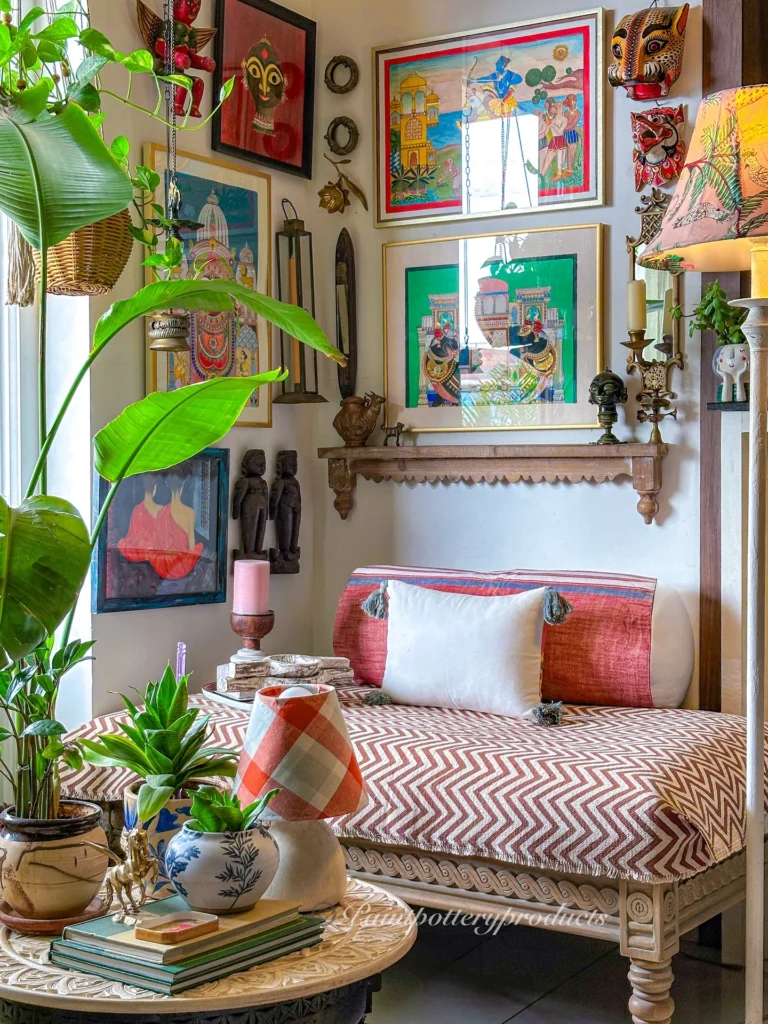
Corners are where blank walls like to hide, and this one is filled from the ceiling down to the seat.
Bright framed paintings in red, green, and blue hang close together with almost no gaps. Painted wooden masks and a brass lantern climb the right side. A carved wood ledge with a scalloped edge sits in the middle and holds small brass figures, so the gallery has a shelf to rest on.
The daybed below keeps the same warm reds. A chevron throw, a striped bolster, and a white pillow with tassels all echo the art, so the bold wall and the seating look like one plan.
Pick one color to run from the wall down to the cushions. Red does that job here, and without it a wall this full would just look noisy.
| Layer | What is on the wall | Why it helps |
|---|---|---|
| Top | Painted masks, a brass lantern, tall framed art | Draws the eye up and fills the high corner |
| Middle | Two large paintings stacked close together | Gives the corner one strong focal point |
| Low | A carved ledge with small brass figures | Links the art to the daybed below |
6. Hexagon Shelves Joined by Ledges Fill a Plain Wall
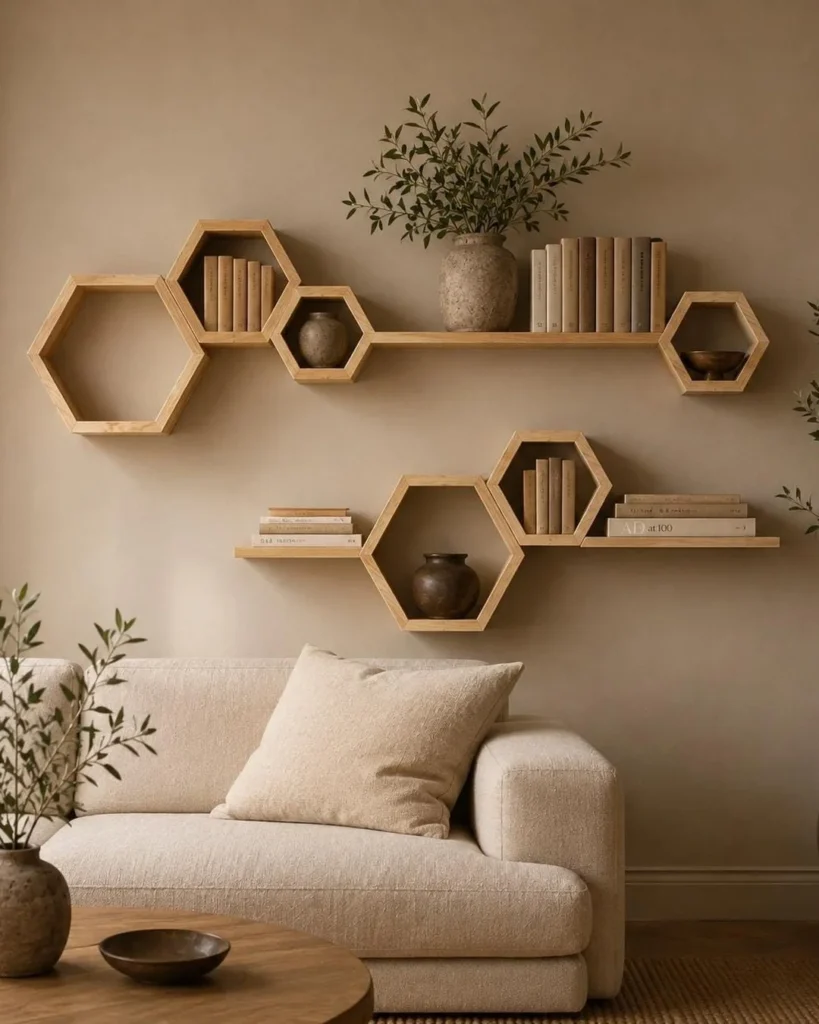
Honeycomb shapes make a flat beige wall look like it has a built-in feature.
Light wood hexagons are linked by two long ledges, so the whole thing reads as one connected piece and not a pile of separate shelves. The two rows are offset, with the top one sitting higher and further left. That keeps it relaxed instead of stiff.
What works here:
- Books in muted spines (tan, cream, soft grey) stack and stand upright, so they act like decor.
- Two or three pots in stone and dark bronze sit inside the hexagons, one object per opening.
- A tall olive branch in a textured vase breaks the straight lines and adds the only real green.
Everything stays in the same warm neutral family as the wall and the sofa. The wood is the only thing that stands out, and that’s why it looks calm and not busy.
Leave a few hexagons empty. The open ones give the eye a place to rest.
Recreate this look
7. Peach Art Prints Turn a Dining Nook Wall Cozy
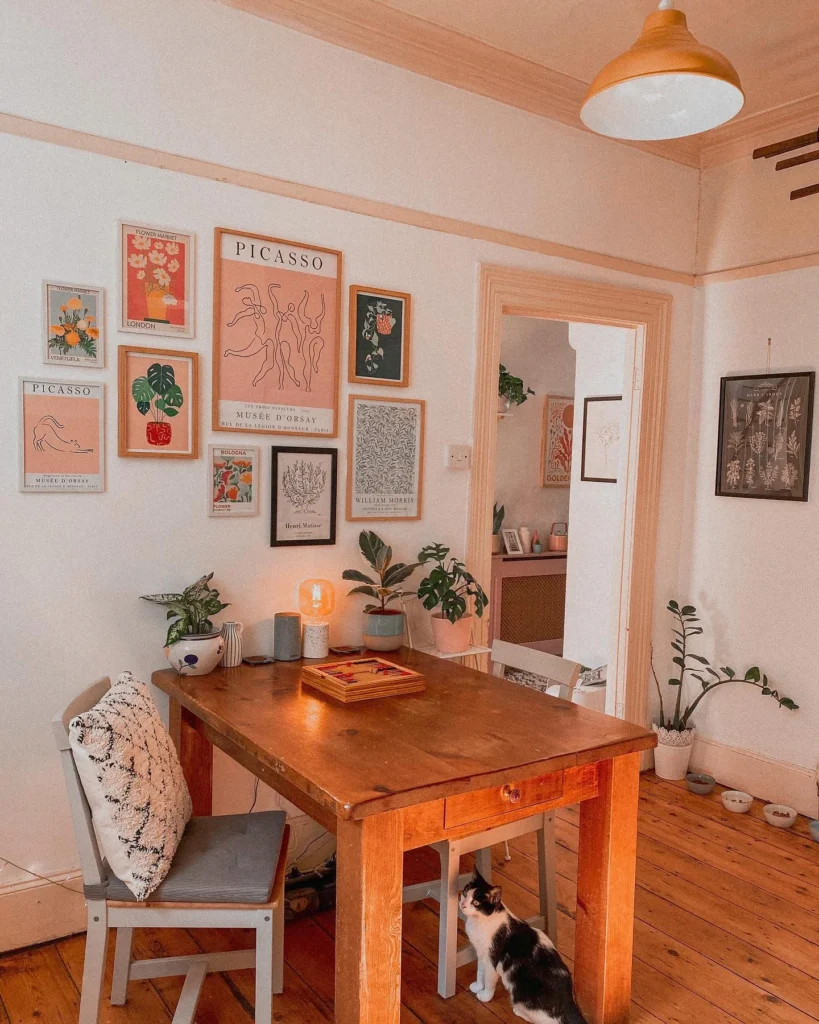
Nine prints share the wall beside this doorway, and none of them match in size. A tall poster sits in the middle as the anchor. Smaller frames pack in around it, with just a thumb’s width between them. The frames mix light oak, white, and black, but the colors inside them keep to peach, orange, and leafy green, with one red pot as a small surprise.
The table below does half the work. Real plants sit right under the plant prints, and a small glowing lamp warms the spot. The art and the plants echo each other, so the cluster feels like part of the room.
On the next wall, a single dark herb print hangs alone in a black frame. It balances the busy cluster, and it keeps the corner from feeling lopsided.
Repeat the colors of your prints in the plants, pots, and lamp nearby, and a mixed frame wall starts to look planned.
8. Botanical Prints in One Warm Palette Fill Bare Walls
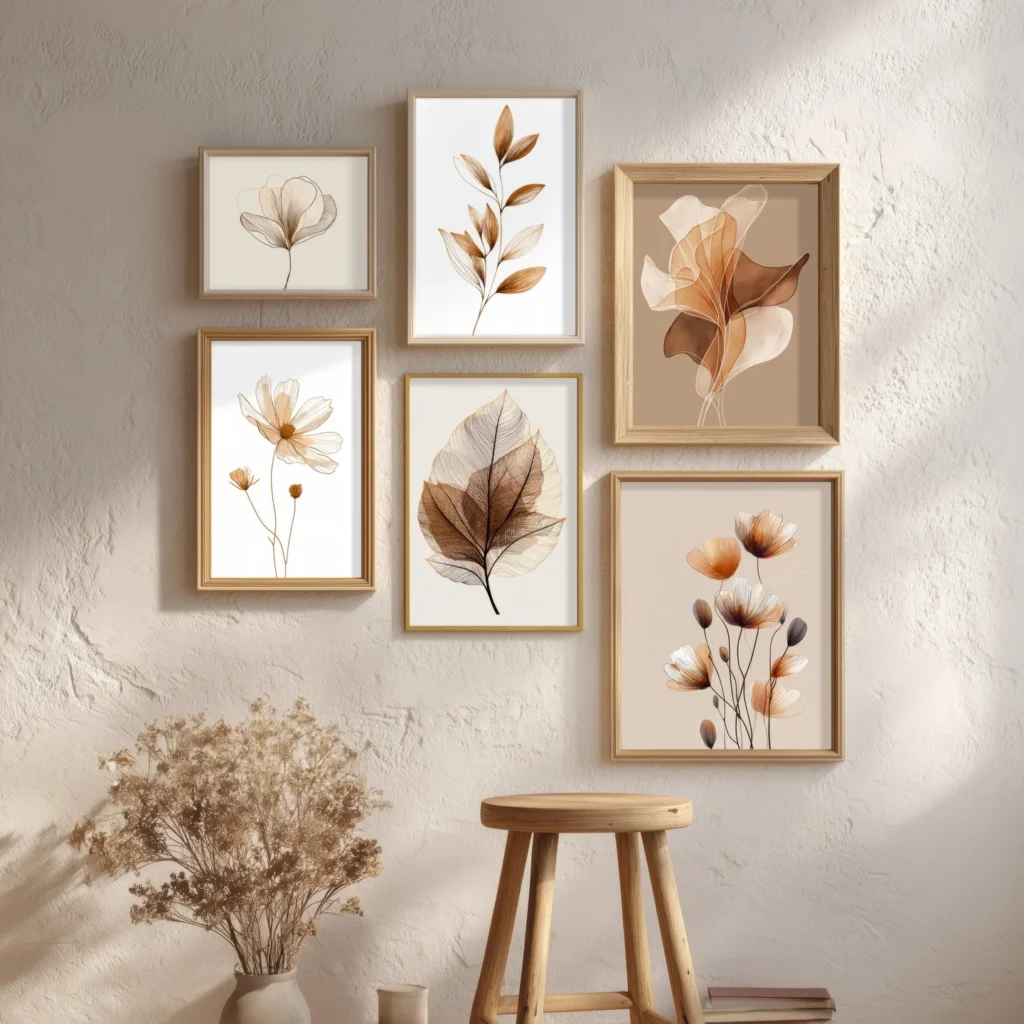
Six prints, one color story. Every piece here is built from cream, caramel, tan, and a little rust, so the group looks calm even though the subjects change from a leaf to a loose flower to a bunch of poppies.
The frames do the mixing:
- Slim light wood on most of them keeps the edges soft.
- One thin gold frame around the leaf print sits in the middle of the group and catches the light.
- Two backgrounds alternate, crisp white and tinted beige. The tinted prints are on the right and add weight to that side.
The groups sit in two loose columns at different heights, which keeps the layout from feeling boxed in. A wood stool and a vase of dried stems sit below, in the same tones as the art. The textured plaster wall and the soft window shadows do the rest, so nothing else needs to hang up there.
💡 Quick Tip
Keep the gap between frames narrow and the same all the way through. Mix the sizes and backgrounds as much as you like, but a steady gap makes the whole group read as one piece.
9. Glowing Half Circle and Slats Turn a Plain Wall
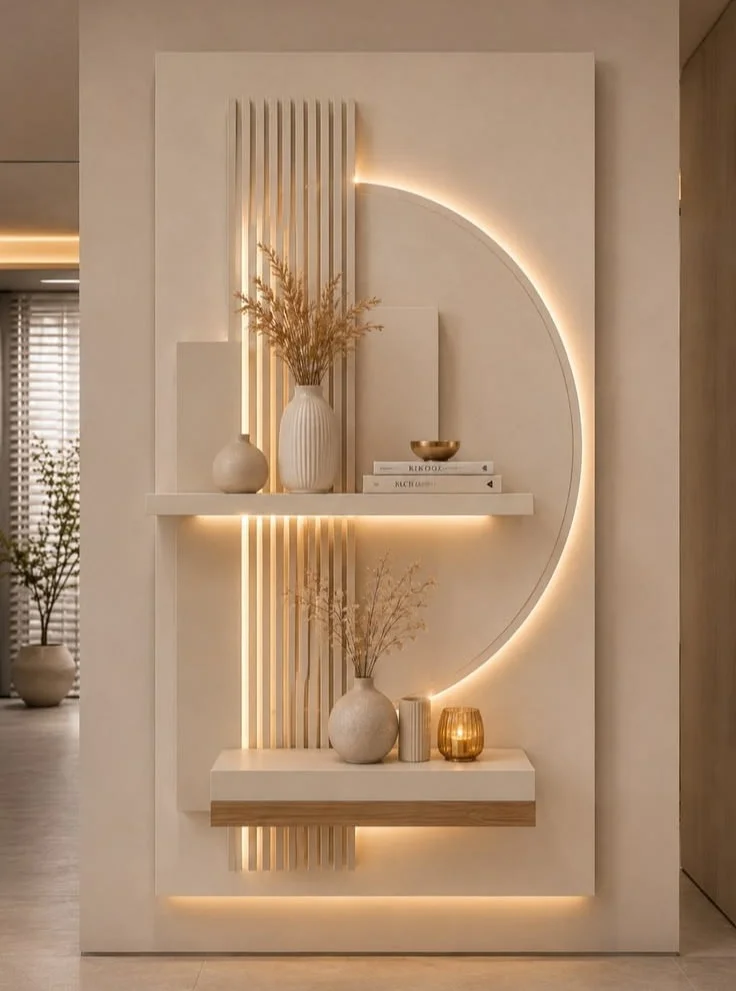
A flat wall at the end of a hall or beside a doorway is a hard blank space, and here it becomes a built-in feature.
A tall cream panel sits slightly proud of the wall. Thin vertical slats run down the left side, and a large half circle curves on the right, outlined with a thin line of warm light. Two chunky shelves cross the panel, and the lower one has a wood edge underneath that adds a strip of natural color.
The styling stays small and quiet:
- Top shelf: a ribbed white vase with dried grass stems, a round stone vase, two stacked books, and a little brass bowl.
- Bottom shelf: a textured vase with dried branches, a slim ribbed cylinder, and an amber glass candle holder.
Every object is cream, tan, or soft gold, so the light does the dramatic part. Because the shelves are the only flat surfaces, the decor has to stay light. Two or three pieces per shelf is plenty.
Plan where the cord for the light will run before you mount anything, since it’s much harder to hide once the panel is up.
A flat, plain wall with nothing to look at and no place to set a vase or a candle.
A raised cream panel with slats, a lit half circle, and two shelves for a few soft neutral pieces.
10. Carved Wood Brackets Make a Narrow Wall Feel Full
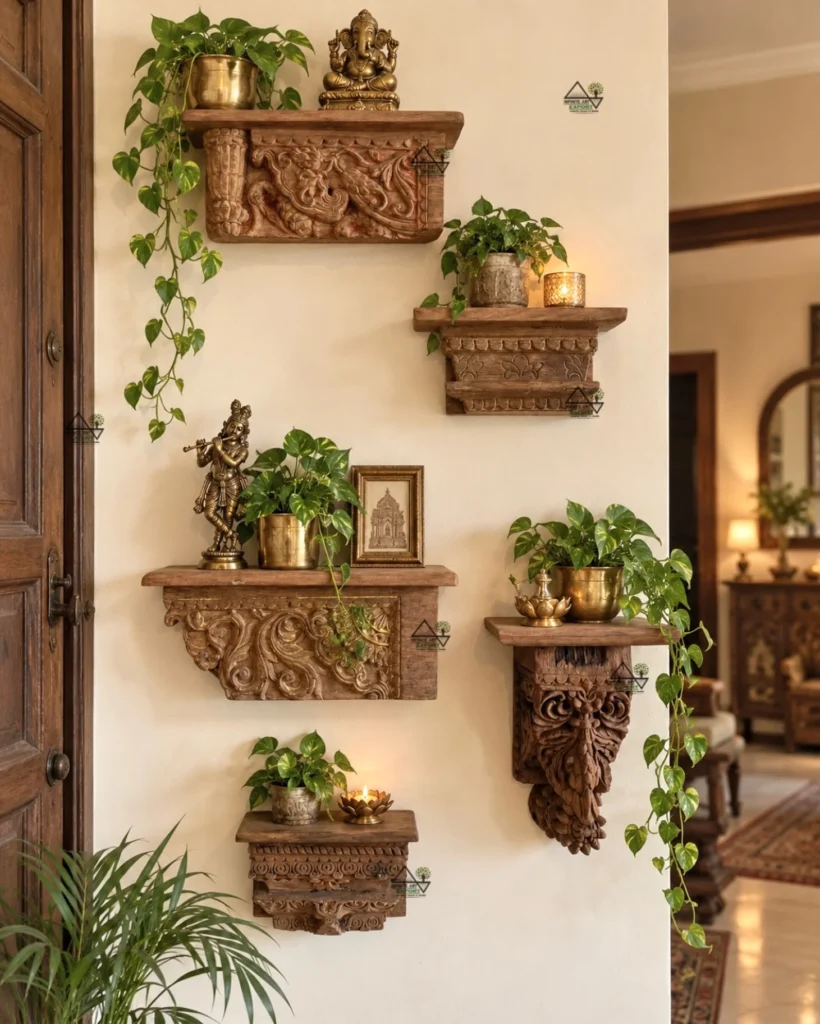
Five shelves, five different carvings, and the wall beside this door never feels bare.
Each bracket is deep, old looking wood with its own pattern, from curling vines to a heavy carved face. Because the carvings are so detailed, the styling on top stays simple: one brass pot with a green plant, then one small extra piece. That extra piece changes from shelf to shelf. It might be a small brass figure, a little framed sketch, or a glass tea light.
The shelves sit at uneven heights and swing left and right, so the group zigzags down the wall. Trailing vines from the top shelf and the lower right shelf spill past the edges, which softens the hard wood corners and ties the shelves together.
Check the weight before you buy. Solid carved brackets are heavy, and a pot with wet soil adds more, so anchor them into studs or use proper wall anchors.
What sits on each shelf
- ▸Top: a brass pot with trailing vines and a small brass figure
- ▸Upper right: a stone look pot, a green plant, and a glowing tea light
- ▸Middle: a brass pot, a tall figure, and a small gold framed sketch
- ▸Lower right: a brass pot with long vines and a small lotus shaped holder
- ▸Bottom: a small pot with a plant and a brass candle holder
11. Pink and Black Prints Brighten the Landing Above Stairs
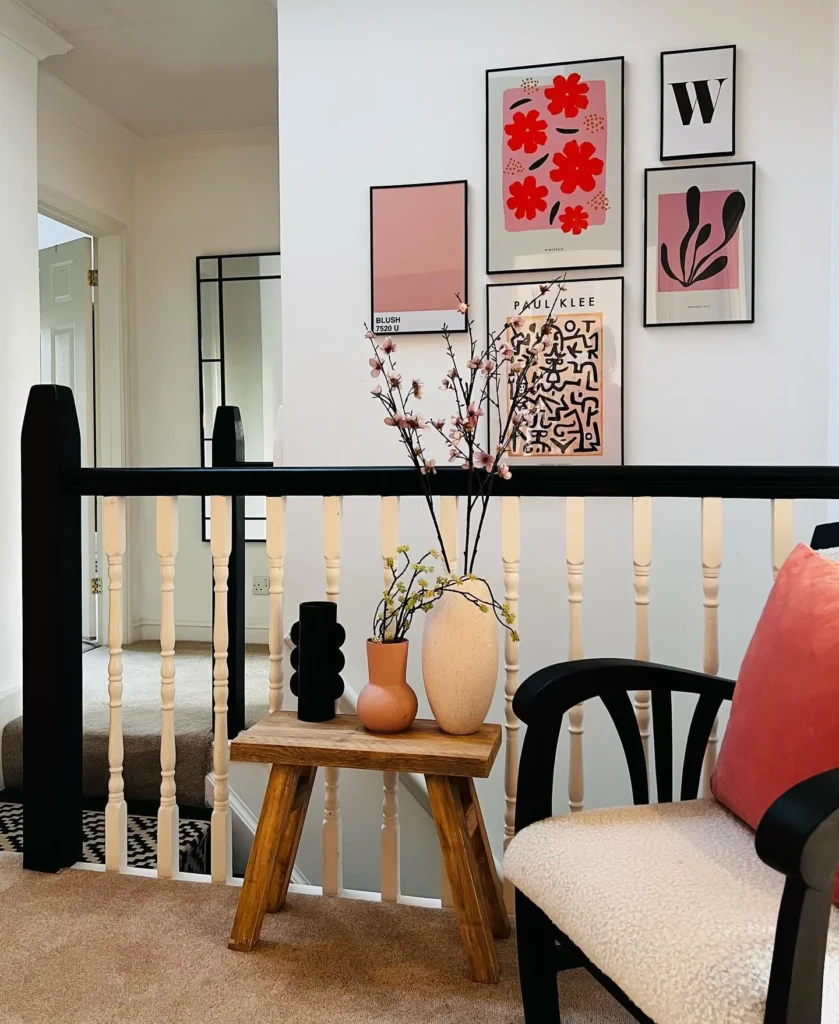
The black frames are what hold this group together. Five prints in one finish share the wall, and the art inside them swings between soft blush, loud poppy red, and bold black shapes.
The sizes are doing the work too. One tall print leads, and a slimmer one sits beside it with two smaller prints stacked around it. A plain blush color print and a single large letter give the eye a quiet place to land between the busier pieces.
The landing below picks up the same colors, so nothing floats on its own. A rough wood stool holds three vases in black, terracotta, and cream, and tall blossom branches rise up toward the frames and link the stool to the wall. The coral cushion on the chair repeats the pink once more.
Watch the railing line. Hang the lowest frame well above the handrail, or the stairs will crowd it.
The color story on this landing
Conclusion
A bare wall is really just a small project waiting for a plan. Start with the shape of the space, whether it’s tall, narrow, slanted, or wide, and let that decide if you need shelves, frames, or a mix of both. Keep the colors tight, leave a little air between pieces, and add something living or glowing if you can.
You don’t need to copy any of these walls exactly. Borrow the one detail that suits your room, and the rest will follow. Save this post for the next time you want fresh empty wall decor ideas.